
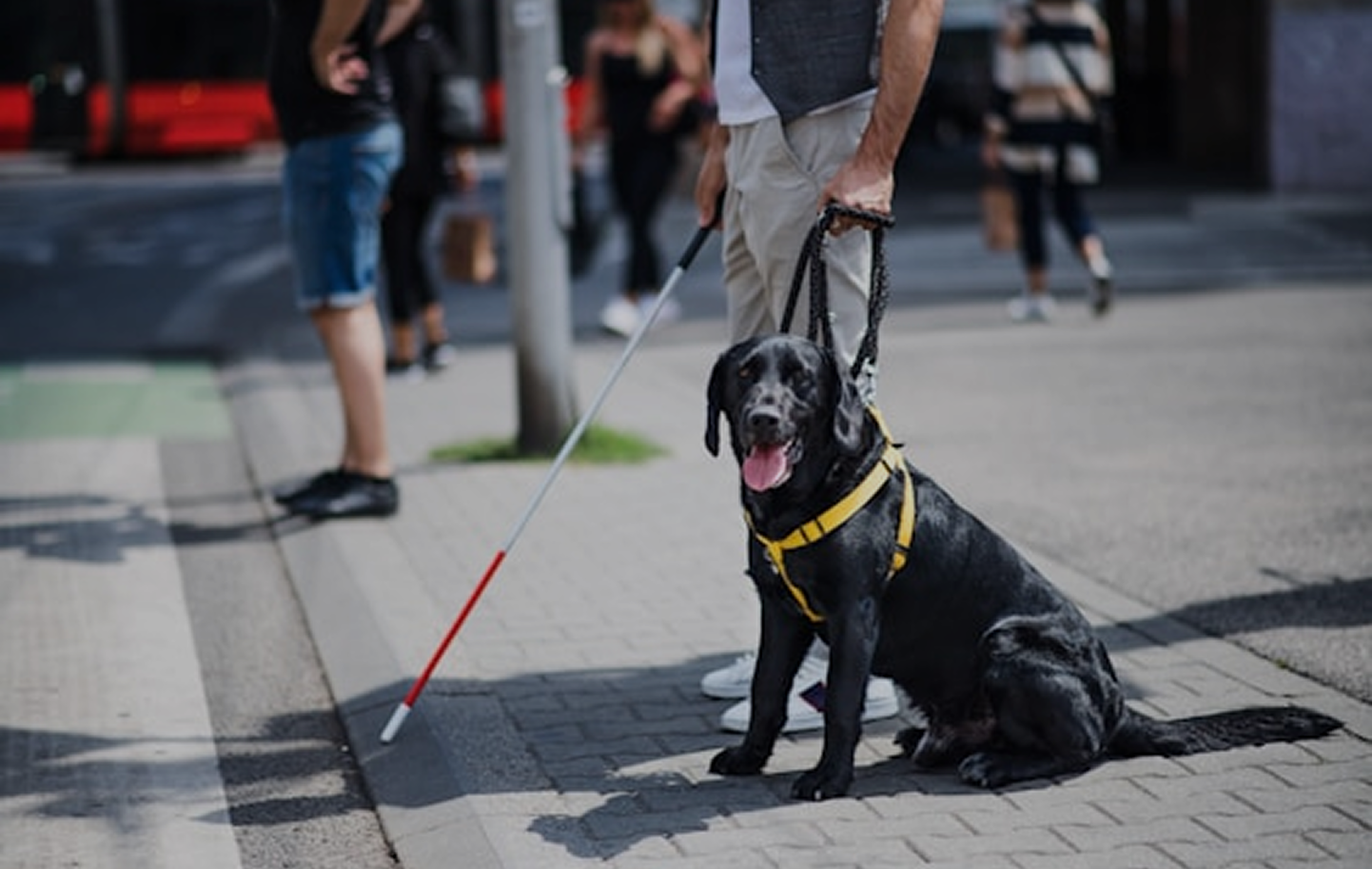
Assistance dogs
Service Dogs (SVAN)
A service dog is one that has been individually trained by a recognized training center to perform tasks for the benefit of a person with a disability or another similar medical condition, whom it accompanies and is permanently linked to.
Recognized Assistance Dogs
We consider assistance dogs to be those listed below, as long as they provide documentation proving their status:
Guide dogs, which assist people with visual impairments or disabilities.
Service dogs, which support people with physical disabilities.
Signal dogs, which assist people with hearing disabilities by alerting them to certain sounds and their source.
Medical alert dogs, which accompany people with diabetes, epilepsy, or other illnesses that involve loss of consciousness and sensory disconnection.
Dogs for people with autism spectrum disorders.
Rescue dogs with completed training to collaborate and assist the State Security Forces, accompanying a rescue team with appropriate harnesses and traveling without occupying a seat.
Dogs in training with a sufficient level to complete the flight with appropriate behavior, provided they are accompanied by their trainer and with an original certificate issued by the organization they serve.
Traveling with a Service Dog
To travel with your service dog in the cabin for free on any of our flights, you must:
We recommend contacting us to inform us that you will be traveling with a service dog at least 48 hours in advance so that we can confirm there are no issues with your flight.
Accredit the service dog status.
Comply with the obligations regarding documentation, health conditions and control of your dog on board.
Ensure that the behavior of the service dog in the cabin is appropriate.
If any of these requirements are not met, the transportation of the dog will be subject to the conditions for traveling with animals.
Flights to/from the United States
On our flights originating from and/or destined for the United States, a set of special rules and criteria derived from U.S. federal service animal regulations, revised in 2021, applies:
A service dog is considered to be any dog, regardless of breed or type, trained to perform work or tasks for a person with a disability, whether physical, sensory, psychiatric, intellectual, or other mental disability. In these cases, a maximum of two dogs per person is allowed.
We recommend contacting us at least 48 hours before departure if you are traveling with a service dog.
You must complete the following Iberia form and submit it to the check-in counter staff.
Accreditation
This accreditation must be done before boarding by presenting one of the following documents:
Official dog identification and card, letter, or accreditation recognizing the service dog and its user, issued by the competent authority of their state or region.
Accreditation, card, or document issued by the organization that trained the service dog stating that it is a member of the International Guide Dog Federation (IGDF) or Assistance Dogs International (ADI), or the guide dog user credential issued by the Spanish National Organization of the Blind (ONCE).
Documentation
You must comply with all legal procedures and documentation, as well as accreditation of vaccines required by the destination country with an official health document.
Location on board
The service dog must be placed at your feet, without obstructing the aisle and without occupying the space for other passengers. For safety reasons, you cannot sit in the seats corresponding to emergency exit rows.
Dog behavior on board
It must always be under your control, secured with a leash and collar, or a guide harness or other restraint mechanism.
You must not allow the dog to roam freely in the cabin, occupy other passengers' space, or cause inconvenience to them.
If necessary, you can request assistance from the cabin crew to move safely and maintain control of your dog.
Reasons for denied boarding
Failure to present the necessary documentation proving it is a service dog.
The dog shows obvious signs of poor hygiene or has external parasites such as fleas or ticks.
The dog displays aggressive behavior, including growling, barking, or attempts to bite that cannot be controlled by the handler.
The dog cannot remain calm and lie at its handler's feet, showing behavior that may compromise safety or comfort on board.
Flying with dogs to the United States
Starting August 1, 2024, U.S. health authorities (CDC) have established additional requirements for admitting all dogs into the country, regardless of whether they travel in the cabin, in the hold as checked baggage, or as service dogs. You can consult the new regulations via the official CDC website (English only).
As a new requirement, you must complete this official form a few days before traveling. In the yellow box at the top, you must indicate whether the dog has been in any high-risk rabies area in the past six months. Depending on your answer, additional information will be required.
Once completed, you will receive a confirmation that must be shown in printed or digital format at the Iberia check-in counters both on your departure day and upon arrival in the United States, along with the rest of the mandatory documentation applicable to your dog.
If your dog has been in a high-risk area and you do not have a valid U.S. vaccination certificate or an export health certificate approved by the USDA, it may only be admitted through one of the six airports with CDC animal care facilities: Atlanta, Los Angeles, Washington, New York, Miami, or Philadelphia, and only if you have reserved accommodation for your dog at those facilities.